
HISTORY
ABORTION
Plymouth & Massachusetts Bay Colonies Bring British Common Law to America Banning Abortion after Quickening (1620 & 1630 AD)
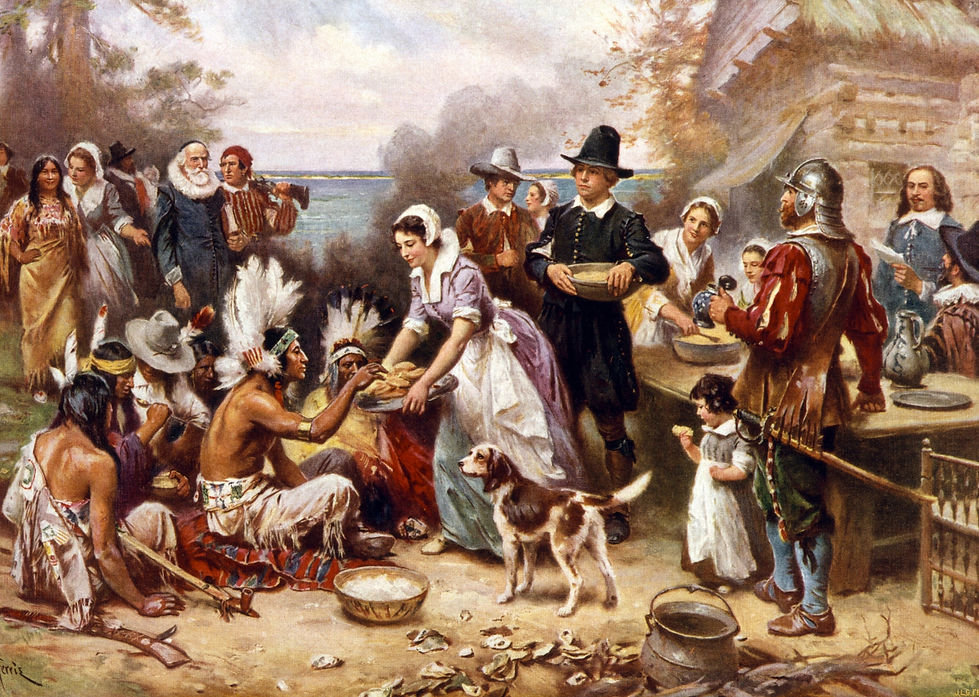
Jean Leon Germone Ferris, “The First Thanksgiving 1621” (Cleveland, OH: The Foundation Press, 1932), Public Domain.
Housed at the Library of Congress (Washngton DC, U.S.), accessed 16 March 2024 at: https://www.loc.gov/resource/cph.3a17442/.
The Plymouth Colony established by Plymouth Brethren (Christians) in Pennsylvania (1620) and the Massachusetts Bay Colony, which was mostly puritans, established in 1630, are two of the earliest successful colonies in the New World. As British colonies, they employed British Common Law with its informal laws and regulations for family life, including a general ban on elective abortion after the quickening (detectable fetal movement), ( 1 ) and a ban on no-fault divorce. But being in the early 17th century, these pioneers would have also been influenced by enlightenment humanism, including individual liberty, human rights, classicalism, the scientific revolution, and faith in the human spirit to solve most every problem. The dominant social ethic of that time would have been early-modern Christian ethics including Christo-centric family values. That means binary gender, conservative sexual ethics, a strong emphasis on personal responsibility, and a general humanitarian ban on abortion (as dangerous to women, anti-family, and a violation of the perceived “natural order”). Of course, these idealistic influences were never perfectly applied. And there were likely exceptions and oversights. Nevertheless, British Common law drew the line against abortion at the “quickening” (detectable fetal movement; around 16-20 weeks). While some claim this means “Abortion was legal back then”, that interpretation is misleading. It’s true that human life was widely identified with conception - dating back at least to the 2nd century AD. But, the conception view is not universally held. And some would distinguish biological life (beginning at conception) from spiritual life (beginning at ensoulment - at the quickening). Regardless, the quickening was a more practical and enforceable cut-off point since the mother would often begin to “show” by that point. This fairly late cutoff point, therefore, did not likely reflect any intentional “abortion-choice” culture, as if abortion was considered a social good back then. More likely, there were practical enforcement problems, given that there was little to no police force, no standing military force, little to no judicial system and it was just too impractical to regulate anything earlier than 16-20 weeks, since many women could hide their pregnancy up to that point. Additionally, modern science had not yet settled the issue on when new human life begins since these colonies long predate the fields of genetics, DNA, and microbiology.
Botanist Carolus Linnaeus Publishes his 10th edition of Systema Naturae Describing “4 Races of Man” (1759 AD)
Carl Linneaus is widely credited with devising the modern classification system for the biological world. In his work, Systema Naturae (1st ed. 1735), he famously identified humankind as a species of animal, a decision with huge theological ramifications.


Europaeus albus: (European white)
Americanus rubescens: (American reddish)
Asiaticus fuscus: (Asian tawny)
Africanus niger: (African black) ( 2 )
Table of the Animal Kingdom (Regnum Animale) from Carolus Linnaeus's first edition (1735) of Systema Naturae.
Carl Linnaeus, Public domain, via Wikimedia Commons
Most of his peers would say mankind is “specially created” by God, and in the image of God (Gen. 1:26-28). In their view, it’s degrading to identify mankind as an animal. If people are animals, what’s to stop people from acting like animals?

What’s to keep people from descending into barbarism, rape, infidelity, abuse, killing unwanted children, etc.? Nevertheless, Linnaeus maintained that humankind is part of the animal kingdom, and “humans” are distinguished Homo sapiens. This category applies to human beings, at all stages of human life, start to finish. In 1759, he published the 10 edition introducing the first full description of the four races or sub-species of man. This concept, now discredited, would play a substantial role in the pseudo-scientific theory known as “scientific racism” wherein the different races are thought to represent different stages of human evolution, with white people being the most evolved.
Alexander Roslin, “Carolus Linnaeus”, oil on canvas (1775). Housed at the National Museum (Stockholm, Sweden). Public Domain. Accessed 16 March 2024 at: https://upload.wikimedia.org/wikipedia/commons/thumb/4/41/Carl_von_Linn%C3%A9%2C_1707-1778%2C_botanist%2C_professor_%28Alexander_Roslin%29_-_Nationalmuseum_-_15723.tif/lossy-page1-3032px-Carl_von_Linn%C3%A9%2C_1707-1778%2C_botanist%2C_professor_%28Alexander_Roslin%29_-_Nationalmuseum_-_15723.tif.jpg
Petrus Camper Develops his “Facial Angle” Formula Lending a Scientific Veneer to Racism and later Eugenic Theory (1770 AD)
Building on Carolus Linnaeus’ theory of 4-races, Dutch professor Petrus Camper attempted to formalize those categories with exact measurements, notably of the face and skull (in a branch of science known as “craniometry”). He presented his theory of the ideal facial angle, in the course of dozens of drawings, spanning two lectures to the Amsterdam Drawing Academy in 1770. ( 3 ) Leaning heavily on classical and Anglo-European influences, he appealed to the “ideal angle” as derived from ancient Greek statues. He argued that Caucasian cranial features conform more closely to the ideal angle, whereas “negro” and other cranial types, are too obtuse or acute to qualify as ideal. Camper was one of the first people to distinguish the field of “history” from “anthropology” (study of historical and prehistorical human development). Strictly speaking, craniometry is just the scientific measurement and categorization of cranial features. But, in that era, craniometry was largely a servant to racist pseudo-science, for delineating “superior” and “inferior” races.


Sketches from Treatise by Petrus Camper on the natural difference of characteristics in people of different types and ages; about the beauty in ancient statues and carved stones. Followed by a proposal for a new way to draw the heads of all kinds of people with certainty. Published after the writer's death by his son Adriaan Gilles Camper (Netherlands, 1791), Public Domain. Accessed 28 March 2024 at: https://en.wikipedia.org/wiki/Facial_Angles_(Camper)
Johann Kaspar Lavater Publishes Essays on Physiognomy Influencing later Eugenics Theories (1772 AD)
Swiss pastor, portrait artist, poet, and dabbling scientist, Johann Kaspar Lavater (1741-1801), first published Essays on Physiognomy in German. ( 4 ) In this work Lavater, with the assistance of his friend and colleague Johann Wolfgang Goethe (1749-1832), lays out the principles of “physiognomy” (face-reading).

According to this theory, people’s character can be assessed by the features of their face, and especially their profile. While physiognomy, has since been debunked as pseudoscience, Lavater’s influence continues in the field of portraiture as he was an acclaimed portrait artist. Physiognomy is a proto-eugenics theory that predates and helped propel the later theory of Phrenology which assessed people’s character and abilities on the basis not just of their face but their cranium. Both tended to treat “white” (Caucasian/anglo) features as superior to the those of non-white people. Both theories lent a scientific façade to later population control and eugenics policies.
Image of woodcut from, Johann KasparLavater, PhysiognomischeFragmentezurBeförderung der Menschenkenntnis und Menschenliebe, 1st ed. (Leipzig, Germany: and Winterhur, Germany: Bey Weidmanns Erben und Reich, und Heinrich Steiner und Compagnie, 1775-1778; reprint ed., 1792). Public Domain. Accessed 28 March 2024 at: https://commons.wikimedia.org/wiki/File:Lavater1792.jpg
Johann Friedrich Blumenbach Identifies 5 Races but only 1 Species of Man (1795 AD)
Johann Friedrich Blumenbach (1752-1840) was a highly-regarded professor, physician, and anthropologist, hailing from Saxe-Gotha in modern day Germany. A contemporary of Carl Linneaus, he grappled with many of the same questions as Linneaus. While Linneaus and Blumenbach agreed that there were real, discernable races, they eventually disagreed over their number and status.

Linneaus settled on four races: white/European; red/Native American, reddish-brown/Asiatic, black/African. Blumenbach originally agreed (more or less) with Linneaus in his earlier work. But by 1795 however, Blumenbach was arguing for five races: Caucasian, Mongolian, Ethiopian, American, and a fifth race, Malaysian. ( 5 ) He based these groupings on patterned facial features, body types, and physiology. More importantly, Blumenbach disagreed over the notion of sub-species. Linneaus affirmed one ascendent (white) race, to where the other races are not “sub-species of humans” but rather “sub-human species” (i.e., scientific racism). Blumenbach, however, saw that people can breed across racial lines, indicating they are all members of the same singular species of man. While prejudice and scientific racism were common in those days, that was not the universal norm. There were exceptions to the bigoted trend.
Engraving by Laurens from the artwork of J.W. Kobolt c. 1804. In the National Library of Medicine. Public Domain. Accessed 28 March 2024 at: https://commons.wikimedia.org/wiki/File:Johann_Friedrich_Blumenbach.jpg
Eugenics and the Influence of Francis Galton (1822 - 1911 AD)
Francis Galton (1822–1911) was a British scientist, statistician, and polymath, and a half-cousin of Charles Darwin. Writing in the wake of Darwin’s work on variation and heredity, Galton became deeply interested in the inheritance of human traits such as intelligence, character, and aptitude. In 1883, he coined the term “eugenics,” drawing from the Greek eugenes, meaning “good in stock” or “well-born.” ( 6 ) He defined eugenics as “the science which deals with all influences that improve the inborn qualities of a race, and also with those that develop them to the utmost advantage.” ( 7 )
Galton believed that human populations, like animal breeds, could be improved over generations by encouraging the reproduction of those he considered more capable or “fit.” While Galton himself often emphasized voluntary encouragement rather than legal compulsion, his ideas framed reproduction as a matter of social planning and laid the intellectual groundwork for later policies that moved well beyond his original proposals. He argued that the practical aim of eugenics was “to cause the more suitable races or strains of blood to prevail over the less suitable,” ( 7 ) a formulation that reduced human value to perceived hereditary merit.
As eugenic thought gained influence in Europe and the United States in the late nineteenth and early twentieth centuries, it became closely entangled with prevailing social hierarchies and prejudices. Eugenics was not a single unified doctrine, but in practice it disproportionately targeted marginalized and vulnerable populations, including the poor, the disabled, racial minorities, and immigrants. Historically, the most widespread and coercive expressions of eugenics were forced sterilization laws, marriage restrictions, and immigration controls. In the United States alone, tens of thousands of individuals were sterilized under eugenic statutes, often without their knowledge or consent. ( 8 )
Although abortion was not a primary or universal instrument of early eugenic policy, debates about heredity and population control influenced broader discussions about birth control, family planning, and the role of the state in regulating reproduction. In later contexts, some advocates and critics raised concerns that abortion could be used selectively to prevent the birth of children with disabilities or other traits deemed undesirable, reflecting assumptions similar to those found in earlier eugenic thinking. ( 9 ) These concerns highlighted the ethical danger of assigning value to human life based on utility, desirability, or genetic traits.
The consequences of eugenic ideology became unmistakably clear during World War II, when Nazi Germany transformed racial-hygiene theories into state policy, resulting in mass sterilization, euthanasia programs, and genocide. In the aftermath of the war, eugenics was widely discredited as both scientifically unsound and morally indefensible. ( 10 ) Nevertheless, its legacy continues to shape modern ethical debates surrounding genetics, reproductive technologies, disability, and human dignity, serving as a lasting warning of the harm that follows when human worth is measured by perceived fitness rather than inherent value.

Museums, Imperial War. "Hitler & Victory Parade, Warsaw." World History Encyclopedia, November 04, 2024. https://www.worldhistory.org/image/19624/hitler--victory-parade-warsaw/.
Slavery Is Banned Across the U.K. in the Slavery Abolition Act of 1833 (1833 AD)
In the early 1800’s, England was among the largest of colonizing forces in the world - a genuine world power. Having one of the strongest navies in the world, England’s sea-faring capacity was almost unrivaled. That meant the U.K. had international access, tremendous capital, and could secure travel, all for seizing economic opportunities in the trans-Atlantic slave-trade. In that era, the most glaring oversight to humanitarian law was not abortion but slavery; as slavery was practiced almost universally, including the U.S. But England was also a “Christian” nation. And whatever ease and convenience the upper-class could enjoy by exploiting slave-labor, there was always moral pushback from Christians and adjacent humanitarian influences of the enlightenment-era.

“William Wilberforce” [Oil on Canvas} by Anton Hinkle (1794). At the Wilberforce House, Hull Museum (England). Public Domain. Accessed 28 March 2024 at: https://commons.wikimedia.org/wiki/File:William_wilberforce.jpg
Among those abolitionist voices was William Wilberforce (1759-1833) who is widely considered the most influential abolitionist in England. With Wilberforce’s activism looming large in the foreground, British Parliament passed the Slave-Trade Act of 1807, abolishing the slave-trade in the United Kingdom. It was still legal to own slaves however since only the trade was forbidden. For reference, the U.S. passed a similar Act the same year, but since these acts didn’t abolish slavery outright, financial incentives, permissive culture, and black-market options kept the slave trade afloat. It wasn’t until the Slavery Abolition Act of 1833 that slavery was abolished outright in the U.K. ( 11 ) It passed the House of Commons on July 26, 1833, and received royal assent August 28, 1833. ( 12 ) Wilberforce died 3 days after it passed (July 29, 1833).
The Seneca Falls Convention Heralds the Start of the Women’s Rights Movement (1848 AD)
![“Ye May session of ye woman's rights convention - ye orator of ye day denouncing ye lords of creation,” by JM’N [Woodcut print], Illustration in: Harper's weekly, 3:128 (1859 June 11), p. 372:](https://static.wixstatic.com/media/cbf429_bebaf524dbd04a5f8e5f76201fc4da7a~mv2.jpg/v1/fill/w_880,h_622,al_c,q_85,usm_0.66_1.00_0.01,enc_avif,quality_auto/cbf429_bebaf524dbd04a5f8e5f76201fc4da7a~mv2.jpg)
“Ye May session of ye woman's rights convention - ye orator of ye day denouncing ye lords of creation,” by JM’N [Woodcut print], Illustration in: Harper's weekly, 3:128 (1859 June 11), p. 372: Public Domain; Held at U.S. Library of Congress (Washington DC), accessed 6 April 2024 at: https://www.loc.gov/item/2005685868/
Before the Civil War, while still in the thick of the industrial revolution, an early form of feminism began gaining steam. As more and more men left the farms to work in factories; work hours stretched to 10, 12, or more hours a day, 6 and 7 days a week. Women were left to fend for themselves at home: running the household, raising children, tending the garden, managing finances, running the family business, and so on. Over that cultural cauldron, talk of “Women’s Rights” arose over voting rights (women’s suffrage) and the temperance movement (alcoholism often fueled domestic abuse). These issues would become the defining features of this early form of the Women’s Rights Movement, known as “first wave feminism.” First wave feminism (1848-1962) was also marked by staunch opposition to abortion. Nineteenth century medicine, technology, and social standards did not look kindly on abortion. To have an abortion was still quite dangerous for women, as it often meant those women were exploited, abused, pressured, and coerced into perilous abortion procedures. And with the rate of medical technology, it wasn’t until the mid-20th century before one could reasonably expect the abortion to be “safe” for the mother. As such, “anti-abortion” was the standard position for at least the first 100 years of feminism. So, when the Seneca Falls convention was occurred in 1848, there was no dispute over abortion-ethics, no serious question about their anti-abortion stance. Abortion just wasn’t in view. Rather the focus was on women’s struggle for quality in matters of land and business ownership, inheritance rights, access to banking, loans, fair hiring, voting rights and rampant domestic abuse. Many of these inequalities were holdovers from British Common law and the “old world” (monarchism, rural homes, farm-based economies). Compounding, and sometimes competing with that social issue was a growing opposition to slavery (abolitionism), raising people’s awareness of societal injustices.

Elizabeth Cady Stanton, “Declaration of Sentiments” (Seneca Falls, NY: Seneca Falls Convention, 1848), public domain. Accessed 6 April 2024 at: https://www.ecswc.org/declaration-of-sentiments

“List of Signatures to the Declaration of Sentiments” (Seneca Falls, NY: Seneca Falls Convention, 1848), public domain. Accessed 6 April 2024 at: https://en.wikipedia.org/wiki/Declaration_of_Sentiments#/media/File:Woman's_Rights_Convention.jpg
Elizabeth Cady Stanton, “Declaration of Sentiments” (Seneca Falls, NY: Seneca Falls Convention, 1848), public domain. Accessed 6 April 2024 at: https://www.ecswc.org/declaration-of-sentiments
There were earlier proto-feminists voices to be sure, but feminism was not really announced to the world until Elizabeth Cady Stanton (1815-1902) and Lucretia Mott (1793-1880) joined forces to organize the Seneca Falls Convention in Seneca Falls, New York. That’s considered the inauguration of the Women’s Rights Movement in the modern era. Mott and Stanton split most of the speaking opportunities in front of a mostly female crowd. Men were allowed to attend, but were asked to remain silent until day two. There were no black women. But there was a lone black man attending: a former slave, noted abolitionists, and guest speaker Frederick Douglass (1817-1895). Key to the convention was the reading of the Declaration of Sentiments. ( 13 ) Modeled after the Declaration of Independence, authored primarily by Stanton. Of the roughly 300 attendees, 100 signed this now famous declaration of women’s rights (68 women and 32 men).
Charles Darwin Publishes Origin of Species by Means of Natural Selection (1859 AD)
Charles Darwin was a British biologist who published perhaps the most influential scientific text of all time: On the Origin of Species By Means of Natural Selection (1859), ( 14 ) followed by, The Descent of Man (1871). In these texts he advanced his theory of evolution as the chief explanation for the diversity of life. Although not an entirely new theory in 1859, his publishing was unique in arguing for random mutation as the mechanism of change.
Additionally, he incorporated an astonishing breadth of examples, drawn from his expedition in the Galapagos Islands. He argued, from a naturalistic and atheistic perspective, that all life on earth emerged from the slow ebb of natural change over time, by way of random mutation and natural selection, without any “special” divine creation. In this view, human beings are animals originating from the same evolutionary forces as every other animal. Around the same time, in 1865, Gregor Mendel began publishing his findings in the field of genetics, which complemented Darwinism, by offering a genetic explanation for Darwin’s claims about random mutations and inherited traits. Darwinian evolution, or just “Darwinism,” ascended in the academy, eventually taking root in the social sciences.


The “survival of the fittest” was soon applied to human society, which didn’t bode well for race-relations, human rights, or the sanctity of human life. If man is just another animal, then mankind is not a special creation of God, “in His image,” with no “sanctity of life,” nor endowed with God-given rights (ex., Declaration of Independence). Social scientists, social planners, and population control advocates, an then interpret all humanity in terms of preferred traits, ranking the races as “more” or “less” evolved. Instead of a robust basis for equal human rights in timeless, universal, transcendent reality, there is instead, the state of nature, red in tooth and claw, tyrannizing and destroying the weak, favoring the fit and the fortunate. Humanity, at least in early Darwinian thought - is roughly the opposite from what Judeo-Christian thought teaches. Not surprisingly, this Darwinian outlook played a major role in eugenics practices offering a rationale for forced sterilization and even extermination of ‘unfit’ people, “culling the herd” of humanity to achieve healthier, smarter, better-looking populations in the future. Darwinian thought would take many forms over the years, itself “evolving” to overcome critiques like those above. To be fair, Darwin’s work doesn’t require all the baggage of eugenics, scientific racism, and social evolution. Darwinism strictly speaking, is descriptive not “prescriptive” (it doesn’t say how things “should” be). But it would be naïve revisionism to pretend that Darwinism didn’t energize 19th and 20th century scientific racism and progressive eugenics policy. Regarding abortion, Darwinian evolution offers no protection for the “sanctity of human life.” And factual sense of “inherent human rights” dissolves into aimless change over time. Human rights then are just trivial conventions, idles and preference, without any truth value or firm moral grounding.
Charles Darwin, On the Origin of Species by Means of Natural Selection or the Preservation of Favoured Races in the Struggle for Life (London: John Murray, Albemarle Street, 1859), cover page, Public domain. Accessed 6 April 2024 at: https://en.wikipedia.org/wiki/On_the_Origin_of_Species#/media/File:Origin_of_Species_title_page.jpg
“Charles Darwin” (Portrait) by Henry Maull and John Fox, 1854, published in Karl Pearson, The Life, Letters, and Labours of Francis Galton (London: Cambridge, 1914), held by University College London Digital Collection (18869). Public Domain. Accessed 6 April 2024 at: https://commons.wikimedia.org/wiki/File:Charles_Darwin_seated.jpg
The Civil War Ends: Slavery Is Abolished (1865 AD)

“Bombardment of Fort Sumter,” by Currier and Ives (1861). Held by Library of Congress. Public Domain. Accessed 6 April 2024 at: https://commons.wikimedia.org/wiki/File:Bombardment_of_Fort_Sumter.jpg
The first shots of the American Civil War were fired in Fort Sumter, SC on April 12, 1861. The Civil War, a.k.a., “the War between the States” or even “the War of Northern Aggression,” would become the bloodiest war in U.S. history with more US casualties than any armed conflict before or since. Some argue that this war was fought primarily over state’s rights, or over secession, but without a doubt, slavery was the dominate issue motivating secession and fueling debate over state’s rights. Notably, it was over the Trans-Atlantic slave trade with Africa. For that reason, the general consensus among historians is that the Civil War was fought primarily over slavery. As long as fellow human beings are legally treated like property, subjected to forced labor, harmed, and even killed at will, then there’s a hollow ring to all the vaulted ideals of our forefathers: “all men are created equal,” “endowed by their creator” with “unalienable rights to life, liberty, and the pursuit of happiness.” To be sure, there were some non-black slaves, and not all slave-owners were white. Some were native American. Some were free blacks. But, there is little question whether the majority slave population was black, and whether the majority of slave-owners were white. The Civil War ended with Confederate General Robert E. Lee surrendering to Union General Ulysses S. Grant on April 9, 1865 at the Appomattox Court House (Virginia). The Confederacy was defeated. The Union had won. Institutional slavery ended only with great bloodshed. This Union victory set off a series of landmark victories for Black Americans. Several dehumanizing and racist court cases were overturned, including the Dred-Scott decision (1857). ( 18 ) And the next three constitutional amendments formally abolished slavery (13th Amendment; 1865), ( 15 ) extended citizenship (14th amendment; 1868) ( 16 ) and secured voting rights (15th amendment; 1870) for Black Americans. ( 17 ) Time will tell if the most basic humanitarian protections will ever be consistently applied to all human beings - including those in utero - but as it stands now, it’s at least illegal to treat some human beings as disposable sub-human property. Pro-choice abortion laws, sadly, remain a glaring exception to the general ban on “human property.”

Page Citations & Notes
1. Blackstone, William. Commentaries on the Laws of England. Oxford, 1765–1769. Avalon Project. Referenced for: the page’s summary that British common law treated abortion after quickening as punishable and that early British colonies in North America inherited that common-law framework.
2. Linnaeus, Carl. Systema Naturae, 10th ed. Stockholm, 1758. Quoted/reference point: the page cites Linnaeus for the fourfold racial categories “Europaeus albus,” “Americanus rubescens,” “Asiaticus fuscus,” and “Africanus niger.”
3. Camper, Petrus. The Works of the Late Professor Camper, on the Connexion between the Science of Anatomy and the Arts of Drawing, Painting, Statuary, &c. &c. Translated by Thomas Cogan. London, 1794. Referenced for: the page’s discussion of Camper’s “facial angle” and its later use in racialized craniometry.
4. Lavater, Johann Kaspar. Essays on Physiognomy. Referenced for: the page’s summary of physiognomy as face-reading and its later influence on phrenology, eugenics, and racial hierarchy claims.
5. Blumenbach, Johann Friedrich. On the Natural Variety of Mankind. 3rd ed. 1795. Referenced for: the page’s discussion of Blumenbach’s five-race classification and his view that all races belonged to one human species.
6. Galton, Francis. Inquiries into Human Faculty and Its Development. London: Macmillan, 1883. Quoted/reference point: the page cites this work for Galton’s coining of the term “eugenics.”
7. Galton, Francis. “Eugenics: Its Definition, Scope, and Aims.” American Journal of Sociology 10, no. 1 (1904): 1–25. JSTOR. Quoted/reference points: “the science which deals with all influences that improve the inborn qualities of a race” and “to cause the more suitable races or strains of blood to prevail over the less suitable.”
8. Reilly, Philip R. “Eugenics and Involuntary Sterilization: 1907–2015.” Annual Review of Genomics and Human Genetics 16 (2015): 351–68. Referenced for: the page’s claim that tens of thousands of people in the United States were sterilized under eugenic laws, often without meaningful consent.
9. Lombardo, Paul A. Three Generations, No Imbeciles: Eugenics, the Supreme Court, and Buck v. Bell. Baltimore: Johns Hopkins University Press, 2008. Referenced for: the page’s claim that later critics and advocates connected abortion, population control, and selective prevention of births to eugenic assumptions about desirable and undesirable traits.
10. Weindling, Paul. Health, Race and German Politics between National Unification and Nazism, 1870–1945. Cambridge: Cambridge University Press, 1989. Referenced for: the page’s claim that Nazi racial-hygiene policy exposed the moral and scientific bankruptcy of eugenic ideology.
11. United Kingdom. Slavery Abolition Act 1833 (3 & 4 Will. 4 c. 73). Quoted/reference point: the page cites this act for slavery being abolished across most of the British Empire in 1833.
12. UK Legislation. An Act for the Abolition of Slavery throughout the British Colonies. 1833. Legislation.gov.uk. Quoted/reference point: formal statutory text of the 1833 abolition law.
13. Stanton, Elizabeth Cady. “Declaration of Sentiments.” Seneca Falls Convention, 1848. Elizabeth Cady Stanton & Susan B. Anthony Center for Women’s Leadership. Quoted/reference point: the page cites this declaration as the foundational text of the Seneca Falls Convention and the modern women’s rights movement.
14. Darwin, Charles. On the Origin of Species by Means of Natural Selection; or, the Preservation of Favoured Races in the Struggle for Life. London: John Murray, 1859. Darwin Online. Quoted/reference point: the page cites this work for Darwin’s presentation of evolution by natural selection and highlights the original subtitle phrase “Preservation of Favoured Races.”
15. United States. Thirteenth Amendment to the United States Constitution. 1865. National Archives. Quoted/reference point: cited on the page for the abolition of slavery.
16. United States. Fourteenth Amendment to the United States Constitution. 1868. National Archives. Quoted/reference point: cited on the page for extending citizenship and equal protection.
17. United States. Fifteenth Amendment to the United States Constitution. 1870. National Archives. Quoted/reference point: cited on the page for securing voting rights regardless of race.
18. United States. Dred Scott v. Sandford, 60 U.S. (19 How.) 393 (1857). Library of Congress summary. Referenced for: the page’s claim that dehumanizing legal structures like Dred Scott were later overturned in the wake of the Civil War and Reconstruction.
Narration and or text on this page has been developed with the assistance of the ChatGPT LLM.