
HISTORY
ABORTION
The Judgment of Solomon (1350–1375 AD)
Click each artwork to view it full-sized and other images in it's group.

Artist / Author: Associated with Rudolf von Ems Date: c. 1350–1375 (third quarter of the 14th century) Origin / Region: Bohemia or German-speaking lands (likely Prague workshop)
Artist / Author: Associated with Rudolf von Ems Date: c. 1350–1375 (third quarter of the 14th century) Origin / Region: Bohemia or German-speaking lands (likely Prague workshop)
This illuminated manuscript depicts the biblical moment in which a child’s life is placed in jeopardy to reveal the true mother. Although the threat of violence is present, the narrative ultimately affirms that genuine love chooses sacrifice over death. Medieval audiences understood this scene as a meditation on justice, emphasizing that rightful authority is measured by its protection of the innocent rather than its capacity for force.
The Wives of the Cimbrians Hang Themselves after Killing Their Children (1400–1425 AD)

Workshop: French manuscript workshop Date: c. 1400–1425 Origin / Region: Paris, France

Artist: Jakob Kerver (designer / woodcut artist) Date: 1539 Origin / Region: Bern, Switzerland
Workshop: French manuscript workshop Date: c. 1400–1425 Origin / Region: Paris, France
This artwork depicts a legendary episode in which Cimbrian women kill their children and then themselves rather than submit to Roman capture. Medieval readers encountered the scene as a moral warning against despair and misplaced honor. The image underscores the catastrophic consequences of choosing death over life when fear eclipses moral restraint.
Massacre of the Innocents (1435–1530 AD)

Workshop: Poitiers workshop Date: c. 1475

Workshop: Parisian workshop Date: c. 1425–1430

Workshop: Rennes workshop (France) Date: c. 1445–1450
Workshop: Poitiers workshop Date: c. 1475
Across late medieval Books of Hours and devotional manuscripts, The Massacre of the Innocents is repeatedly depicted as a moral indictment of violence exercised against the most vulnerable. Drawing from the Gospel account of King Herod’s decree to kill the infant boys of Bethlehem, these illuminated miniatures present the event not as political necessity but as a profound injustice. Artists emphasize the physical fragility of children, the anguish of mothers, and the brutality of state power turned against innocent life. In compositions that sometimes juxtapose the massacre with the Flight into Egypt, the images heighten the ethical contrast between preservation and destruction, divine protection and human cruelty. Together, these works function as visual theology, reinforcing medieval moral teaching on the sanctity of life and the enduring condemnation of authority that secures itself through the deliberate killing of the innocent.
Medea Killing Her Sons (1470 AD)

Workshop: England, possibly London Date: c. 1470
Workshop: England, possibly London Date: c. 1470
This English manuscript miniature illustrates the classical myth of Medea murdering her children in vengeance against their father, Jason. Medieval audiences understood the image as a moral exemplum warning against uncontrolled passion and revenge. The scene presents filicide as the ultimate violation of maternal duty and moral order.
Bruegel the Elder’s Massacre of the Innocents (1600 AD)

Artist: Pieter Brueghel the Younger (after Pieter Bruegel the Elder) Date: c. 1600 (after an original composition c. 1565–1567)
Artist: Pieter Brueghel the Younger (after Pieter Bruegel the Elder) Date: c. 1600 (after an original composition c. 1565–1567)
Set within a contemporary Flemish village, this painting reimagines the biblical massacre as an event unfolding in ordinary daily life. By embedding atrocity within familiar surroundings, the artist emphasizes the intrusion of state violence into civilian communities and underscores the vulnerability of children caught in political cruelty.
The Angel of Mercy (1746 AD)

Artist: Joseph Highmore (1692–1780) Date: c. 1746 Origin / Region: England
Artist: Joseph Highmore (1692–1780) Date: c. 1746 Origin / Region: England
In this allegorical painting, an angel intervenes to restrain violence directed toward a mother and her child. Created during the moralizing culture of eighteenth-century Britain, the work presents mercy as a corrective to human brutality. Protection of innocent life is framed as a moral imperative rather than a product of power or circumstance.
In Self Defense (1876 AD)

Artist: A. B. Frost (Arthur Burdett Frost) Date: 1876
Artist: A. B. Frost (Arthur Burdett Frost) Date: 1876
This political cartoon depicts a white former Confederate standing over the body of a murdered African American child, justifying the act as preemptive self-defense. Produced during Reconstruction, the image exposes how fear and dehumanization were used to rationalize violence against children. The work reveals the moral consequences of defining innocence as expendable in the preservation of power.
A Horrible Suicide (1879 AD)

Artist: Tsukioka Yoshitoshi Date: 1879 Origin / Region: Japan
Artist: Tsukioka Yoshitoshi Date: 1879 Origin / Region: Japan
This Meiji-period newspaper woodblock depicts a sensationalized domestic tragedy reported in the popular press. Rather than romanticizing the act, the composition emphasizes chaos, bloodshed, and irreversible loss. The image presents filicide and suicide as moral catastrophe, reflecting broader anxieties surrounding modernity and social breakdown.
Soviet Anti-Abortion Poster (1925 AD)

Artist: Sergey Yaguzhinsky (1862–1947) Date: 1925 Origin / Region: Soviet Union
Artist: Sergey Yaguzhinsky (1862–1947) Date: 1925 Origin / Region: Soviet Union
This Soviet public health poster warns against induced miscarriage by depicting its progression from clandestine procedure to medical collapse and death. The image frames abortion as both a criminal act and a public health catastrophe, emphasizing harm to women, children, and families rather than individual autonomy.
Planned Parenthood Advertisements (1965 AD)

Date: c. 1965 Medium: Printed poster
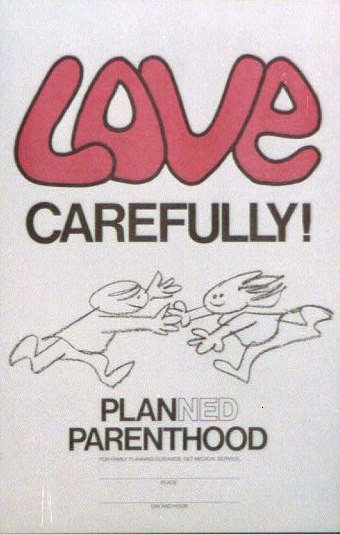
Date: c. 1965 Medium: Printed poster
Date: c. 1965 Medium: Printed poster
Produced during the mid-1960s, these Planned Parenthood posters reflect the organization’s use of modern graphic design and contemporary social language to promote family planning within a rapidly changing cultural landscape. Drawing on the visual vocabulary of the sexual revolution and, in some cases, the moral authority of prominent public figures, the posters present reproductive planning as responsible, progressive, and aligned with broader social reform movements of the Great Society era. Through simplified imagery, bold typography, and carefully framed messages, the materials illustrate how reproductive policy was increasingly communicated as a public good and a matter of personal responsibility, rather than solely a private moral concern. Collectively, these works document the role of visual advocacy in shaping public attitudes toward sexuality, reproduction, and authority in mid-twentieth-century America.
Conclusion
