
HUMANITY
DEFINING
The Colosseum & Crucifixion
The Roman Colosseum and the practice of crucifixion reveal how dehumanization became normalized within Roman society. Both arose from a rigid social hierarchy that ranked human worth by status, citizenship, and perceived usefulness to the state. When individuals were denied recognized dignity, their suffering could be transformed into public spectacle or political instrument without moral restraint.
Gladiatorial games depended on the systematic reduction of human beings to objects of entertainment. Most gladiators were slaves, prisoners of war, or condemned criminals—groups already excluded from social protection. The Roman philosopher Seneca criticized these spectacles, describing the executions as “mere butchery” and condemning the crowd for demanding death “as though it were a show.” ( 1 ) His critique highlights not only the violence itself, but the moral indifference that allowed spectators to view human death as amusement.

Pollice Verso (Thumbs Down) (1872). Oil on canvas, height 96.5 cm (37.9 in). Phoenix Art Museum, Arizona; Jean-Léon Gérôme, Public domain, via Wikimedia Commons
Crucifixion represented an even more explicit form of institutionalized dehumanization. Typically reserved for slaves, rebels, and the lowest criminals, it was designed to inflict prolonged suffering, public humiliation, and social erasure. Cicero emphasized the punishment’s dishonor, declaring that “the very word ‘cross’ should be far removed not only from the bodies of Roman citizens, but even from their thoughts, eyes, and ears.” ( 2 ) His statement reflects the Roman understanding that crucifixion signified the total loss of human and civic dignity.
The crucifixion of Jesus of Nazareth occurred within this same framework. Regarded by Roman authorities as a political threat, he was subjected to the punishment reserved for those considered socially expendable. The historian Tacitus records with characteristic detachment that “Christus… suffered the extreme penalty during the reign of Tiberius at the hands of… Pontius Pilatus.” ( 3 ) The phrase “extreme penalty” reflects how crucifixion functioned as the ultimate expression of state power over a life deemed unworthy of protection.

Crucifixion, etc. (John Beaver, Roman Military Punishments, 1725), print, William Hogarth (MET, 32.35(94)); William Hogarth, CC0, via Wikimedia Commons
Capacocha
Capacocha (qhapaq hucha) was a state-sponsored ritual practiced by the Inca Empire in which children were killed as offerings during moments of political transition, environmental crisis, or religious significance. ( 4 ) Ethnohistoric sources describe these rites as acts of devotion intended to honor deities and sacred places (huacas) and to preserve imperial order. ( 5 ) Children were selected according to criteria that emphasized ritual suitability—often described in the sources as physical health, beauty, and social status—qualities believed to render them acceptable to the gods. ( 6 ) Through this framework, the child’s social identity was transformed from a protected family member into a sacred offering whose death was presented as meaningful rather than violent.
This transformation reflects a structured form of dehumanization rooted in moral abstraction. Rather than being regarded primarily as individuals with intrinsic worth, the children were redefined by their ritual function. Spanish chroniclers, including Bernabé Cobo, report that parents were expected to comply publicly with the ritual logic and refrain from visible mourning, reinforcing the interpretation of the sacrifice as honorable and necessary. ( 5 ) Such expectations reveal how social norms and religious language worked together to suppress recognition of personal loss and to stabilize the moral narrative surrounding the killing.
Archaeological discoveries provide a concrete record of this process. The most prominent example is the Llullaillaco Maiden, a young girl discovered in 1999 on Mount Llullaillaco at an altitude exceeding 6,700 meters. ( 7 ) Exceptionally preserved by freezing conditions, her body shows no evidence of overt trauma or struggle. Scientific analysis of her hair indicates sustained coca leaf consumption and alcohol exposure in the months preceding death, consistent with deliberate ritual preparation and likely sedation. ( 8 ) She was carefully dressed, positioned, and buried with ceremonial objects, indicating reverent treatment even as her life was intentionally ended.
The Capacocha rites, and the Llullaillaco Maiden in particular, demonstrate how dehumanization can occur not through overt cruelty but through sanctification. When a society redefines a human being primarily as an offering or symbolic intermediary, lethal harm can be framed as duty rather than as violence. The ritual context did not deny the child’s importance; it reassigned that importance away from personal dignity and toward cosmological purpose. This ethical pattern—where belief systems and authority converge to eclipse the inherent worth of the vulnerable—appears repeatedly across history and remains a powerful lens for examining the moral consequences of dehumanization.

Johann Reinhard, the well-known researcher, is shown photographing on the summit of Mount Llullaillaco during the rescue of the Inca mummies in 1999.
Johan Reinhard, CC BY-SA 3.0 <https://creativecommons.org/licenses/by-sa/3.0>, via Wikimedia Commons
The Ku Klux Klan (KKK)
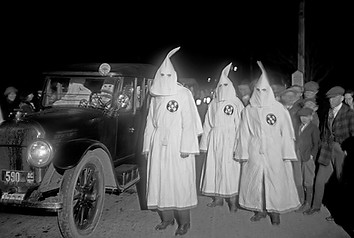
The Ku Klux Klan (KKK) demonstrates how dehumanization can be organized into political terror. Emerging during Reconstruction, the Klan used secrecy, intimidation, and murder to undermine Black citizenship and reassert white dominance. Its governing document, the Prescript of the Ku Klux Klan, emphasized hierarchy, obedience, and secrecy, reinforcing group identity while diffusing accountability for violence. ( 9 )
Congressional investigations in the 1870s recorded testimony that the Klan sought “to control the state government and control the Negro labor, the same as they did under slavery,” revealing how African Americans were treated not as citizens but as instruments of racial control. ( 10 ) This framework supported widespread terror, including lynching.
From the late nineteenth through the early twentieth century, thousands of Black Americans were lynched, often publicly and with little legal consequence. ( 11 ) Journalist Ida B. Wells documented lynching as a form of “social control,” enforcing racial hierarchy through fear. ( 12 ) Victims were portrayed as subhuman threats, making extreme violence appear justified.
Three Ku Klux Klan members at a Ku Klux Klan parade through counties in Northern Virginia.; National Photo Company Collection, Public domain, via Wikimedia Commons
Ota Benga

Ota Benga (second from left) and other Africans at the Louisiana Purchase Exposition.
Unknown; however, image credit is given to The South Carolina Library, University of South Carolina, Columbia, S.C. in The Pygmy in the Zoo., Public domain, via Wikimedia Commons
In the early twentieth century, racial ideology was often presented as science and reinforced through public institutions. One of the most disturbing examples of this dehumanization is the case of Ota Benga, a Congolese man publicly displayed in the United States as a racial curiosity. ( 13 )
Ota Benga, born around 1883, was a member of the Mbuti people of the Congo Basin. His life unfolded amid the violence of the Congo Free State under King Leopold II, where forced labor and village destruction were widespread. ( 14 ) In 1904, he was brought to the United States by Samuel Phillips Verner and exhibited at the St. Louis World’s Fair as part of an “ethnological” display designed to suggest racial hierarchies. ( 13 )

Ground Plan of the Louisiana Purchase Exposition (St. Louis World’s Fair), 1904.
This map shows the full layout of the fairgrounds, including major exhibition halls, state and foreign buildings, landscaped lagoons, and The Pike amusement midway. Anthropological and ethnological exhibits were located within the main exhibition grounds, separate from The Pike; among those displayed at the fair was Ota Benga, though the precise location of his exhibition is not documented. Ellis, W. W., [from old catalog] comp, Public domain, via Wikimedia Commons
In 1906, Benga was placed on display at the Bronx Zoo, housed in the Monkey House alongside an orangutan. ( 15 ) The exhibit reinforced the false belief that Africans were closer to animals than to fully human persons. Contemporary reporting noted that “few expressed audible objection to the sight of a human being in a cage with monkeys as companions.” ( 15 )
Black clergy publicly condemned the display. Reverend James H. Gordon declared, “Our race… is depressed enough, without exhibiting one of us with apes. We think we are worthy of being considered human beings, with souls.” ( 13 ) Public pressure eventually led to Benga’s removal.
Unable to return to Africa and isolated by discrimination, Ota Benga died by suicide in 1916. ( 13 ) His story reveals how dehumanization becomes possible when institutions and pseudo-science deny the inherent dignity of human life.
Soviet Gulags
The Soviet Gulag system emerged from a political culture that systematically redefined targeted populations as threats rather than persons. ( 16 ) Bolshevik ideology increasingly framed social conflict in terms of “class enemies,” encouraging citizens and officials alike to view entire groups as obstacles to be removed for the sake of the collective. ( 17 ) This mindset was reflected in propaganda and official rhetoric that urged vigilance against internal enemies and normalized suspicion as a civic duty. ( 18 ) Once individuals were no longer seen primarily as human beings but as dangerous categories, their removal from society could be presented as both necessary and justified.
This dehumanization was institutionalized through bureaucratic language and policy. NKVD Operational Order No. 00447, issued in 1937 during the Great Terror, authorized mass arrests and punishments of “former kulaks, criminals, and other anti-Soviet elements.” ( 19 ) The term “elements” is revealing: it stripped individuals of personal identity and reduced them to abstract components of a perceived social threat. Such categorization enabled quotas, rapid sentencing, and routine confinement, allowing repression to function efficiently while minimizing moral resistance. ( 20 )
Excerpt of NKVD Order No. 00447: NKVD of USSR, Public domain, via Wikimedia Commons
Within the camps themselves, linguistic reduction continued. Prisoners were commonly referred to as zeks, a term derived from bureaucratic abbreviations for “incarcerated person.” ( 16 ) This shorthand reflected a broader reality in which individuals were treated as interchangeable units of labor rather than as human beings. Forced labor was framed as corrective and productive, further rationalizing extreme deprivation. ( 21 ) Hunger, exhaustion, and high mortality were not treated as moral failures but as acceptable consequences of discipline and economic necessity. ( 22 )

By Uncredited photographer - Page 13 of part II of Vlas Mikhailovich Doroshevich «Sakhalin (Katorga)», Moscow. Sytin publisher, 1905., Public Domain, https://commons.wikimedia.org/w/index.php?curid=9917722

By Russian State Archive, Moscow, Moscow (Російський Державний архів, Москва) - ausstellung-gulag.org, CC BY-SA 3.0, https://commons.wikimedia.org/w/index.php?curid=46062658

Rights: Kauno IX forto muziejus / Kaunas 9th Fort Museum, CC BY 4.0 <https://creativecommons.org/licenses/by/4.0>, via Wikimedia Commons
By Uncredited photographer - Page 13 of part II of Vlas Mikhailovich Doroshevich «Sakhalin (Katorga)», Moscow. Sytin publisher, 1905., Public Domain, https://commons.wikimedia.org/w/index.php?curid=9917722
The Gulag thus illustrates how dehumanization operates not only through overt violence, but through language, administration, and ideology. By redefining people as enemies, elements, or units of labor, the Soviet system created conditions in which mass suffering could be carried out and sustained with chilling normalcy. The history of the Gulag stands as a stark example of how the erosion of human dignity enables large-scale injustice to become routine.

The Holocaust
Dehumanization was not incidental to the Holocaust; it was a foundational mechanism that enabled ordinary people, institutions, and professionals to participate in systematic mass murder. Nazi ideology deliberately reframed Jews not as individual persons with inherent dignity, but as a biological threat to society. As the United States Holocaust Memorial Museum explains, Jews were depicted in Nazi propaganda as “parasitic vermin” whose removal was presented as necessary for the survival of the German people. ( 23 ) Such language was not merely symbolic. By redefining an entire group as subhuman and dangerous, moral restraints against violence were progressively dismantled.
This worldview was formalized through law. The 1935 Reich Citizenship Law declared: “Only a national of German or related blood…is a Reich citizen,” specifying that only such individuals possessed full political rights. ( 24 ) Jews were thereby transformed from citizens into permanent outsiders—legally present but stripped of equality and protection. Historians note that this legal exclusion normalized escalating persecution by embedding racial hierarchy into everyday governance, making discrimination appear lawful and orderly rather than overtly criminal.
Dehumanization also served to psychologically prepare perpetrators for mass violence. In an October 1943 address to SS leaders, Heinrich Himmler openly acknowledged the killing of Jews, referring to “the extermination of the Jewish people” and describing it as a difficult but necessary task carried out by disciplined men. ( 25 ) This framing allowed perpetrators to reinterpret mass murder as moral duty rather than as the killing of human beings, replacing empathy with obedience and ideological loyalty.
Holocaust scholars emphasize that genocide unfolded through gradual stages—classification, exclusion, dispossession, forced labor, and finally industrialized murder—each step made possible by the prior erosion of human status. By recasting Jews as a racial menace rather than as persons, policies of ghettoization, deportation, and extermination were portrayed as rational solutions to a fabricated problem. Euphemisms such as “resettlement” and “Final Solution” further obscured reality, distancing both perpetrators and bystanders from the human cost.

An aerial reconnaissance photograph of the Auschwitz concentration camp showing the Auschwitz I camp. Mission: 60 PR 288 60 SQ; 60. Public domain, via Wikimedia Commons
China One-Child Policy

Propaganda poster at beginning of Chinese economic reforms. Robert Schediwy, CC BY-SA 3.0 <https://creativecommons.org/licenses/by-sa/3.0>, via Wikimedia Commons
China’s One-Child Policy (implemented nationally from 1979 and formally ended in 2015) illustrates how dehumanization can operate through bureaucratic systems rather than overt violence. ( 26 ) Developed to control population growth during economic reform, the policy placed reproduction under state management, requiring official approval for childbirth and continuous monitoring of women of childbearing age. ( 26 ) Births were classified as either “in-plan” or “out-of-plan,” a distinction that implicitly defined human lives by administrative permission rather than inherent dignity. ( 26 ) Scholars note that such classification systems reduce individuals to demographic units, making moral concern secondary to compliance with quotas. ( 26 )
Enforcement mechanisms reinforced this dehumanizing framework. Families who violated birth limits were often subjected to “social compensation fees,” which academic studies describe as ranging from several times to more than ten times a household’s annual income, depending on locality. ( 27 ) These penalties encouraged coercive practices and normalized the treatment of children as economic liabilities. ( 28 ) In this context, pregnancy itself became less a personal reality than a monitored event—something to be prevented, reported, or sanctioned when it fell outside state authorization. ( 26 )
The policy also intensified existing son preference, contributing to a sharply distorted sex ratio at birth. While the biological norm is approximately 105 boys per 100 girls, China’s ratio rose to around 117–120 boys per 100 girls in some regions during the policy’s peak years, a change widely attributed to fertility restriction combined with sex-selective abortion. ( 30 ) Children born outside quotas—often referred to as heihaizi (“black children”)—frequently lacked household registration, limiting access to education, healthcare, and legal recognition. ( 31 ) Viewed through the lens of dehumanization, the One-Child Policy demonstrates how administrative language and demographic targets can erode moral recognition, allowing profound human harm to occur under the guise of routine governance. ( 26 )

China one-child policy propaganda poster. kafka4prez from Planet Earth, Thailand, CC BY-SA 2.0 <https://creativecommons.org/licenses/by-sa/2.0>, via Wikimedia Commons
"Clump of Cells"
Throughout history, dehumanizing language has been used to reduce moral resistance to violence by redefining human beings as objects or abstractions. In abortion discourse, the phrase “clump of cells” functions within this same pattern, linguistically distancing the unborn child from recognizable human identity and moral consideration.
From a scientific perspective, modern embryology does not describe the early human being as a mere aggregation of cells. Authoritative texts consistently affirm that human development begins as an integrated organism at fertilization. Embryologist Keith L. Moore writes, “Human development begins at fertilization when a sperm unites with an oocyte to form a single cell, the zygote… This highly specialized cell marks the beginning of each of us as a unique individual.” ( 32 ) Langman’s Medical Embryology likewise states, “The development of a human being begins with fertilization… giving rise to a new organism, the zygote.” ( 33 ) These descriptions emphasize continuity and organismal unity rather than randomness or biological insignificance.


Laurance, Jeremy. 2008. “A Clump of Cells? Or a Living Being with a Soul?” The Independent, March 26. https://www.independent.co.uk/news/science/a-clump-of-cells-or-a-living-being-with-a-soul-800583.html
The phrase “clump of cells” does not originate in scientific literature but serves as rhetorical framing. Philosopher Hannah Arendt observed that systems of violence rely on language that obscures moral reality, ( 34 ) while George Orwell warned that political language is often used “to make murder respectable.” ( 35 ) Bioethicist Leon Kass similarly cautioned that language which conceals humanity prepares the way for treating human beings as disposable. ( 36 )
In abortion debates, reducing the unborn child to impersonal biological material diminishes moral salience and eases ethical conflict. Ethicist Daniel Sulmasy has noted that depersonalization removes the perceived victim from moral concern, making harm psychologically easier to justify. ( 37 ) This linguistic strategy echoes historical precedents in which human beings were first redefined—as “property,” “parasites,” or “burdens”—before being excluded from protection.
The ethical concern surrounding the term “clump of cells” is therefore not merely semantic. It reflects a broader pattern in which denying human identity precedes denying human rights. As philosopher Robert Spaemann observed, “One can always declare in advance that the being killed was not a person.” ( 38 ) History repeatedly demonstrates that when language diminishes humanity, the threshold for violence is lowered.

Pro-choice and anti-abortion demonstrators stage concurrent events outside the United States Supreme Court Building, Washington DC, April 26, 1989.
Lorie Shaull from St Paul, United States, CC BY-SA 2.0 <https://creativecommons.org/licenses/by-sa/2.0>, via Wikimedia Commons

Page Citations & Notes
1. Seneca. Epistulae Morales ad Lucilium [Moral Letters to Lucilius], Letter 7. Wikisource direct text. Quoted/reference point: 7.3–5, including Seneca’s criticism of executions as “mere butchery” and the crowd treating death “as though it were a show.”
2. Cicero. In Verrem 2.5. Attalus. Quoted/reference point: 2.5.165, “the very word ‘cross’ should be far removed not only from the bodies of Roman citizens, but even from their thoughts, eyes, and ears.”
3. Tacitus. Annals. LacusCurtius, Book 15 direct text. Quoted/reference point: 15.44, “Christus… suffered the extreme penalty during the reign of Tiberius at the hands of… Pontius Pilatus.”
4. Reinhard, Johan. The Ice Maiden: Inca Mummies, Mountain Gods, and Sacred Sites in the Andes. Washington, DC: National Geographic, 2005. Referenced for: Capacocha as a state-sponsored Inca ritual involving child sacrifice during moments of political transition, environmental crisis, or religious significance.
5. Cobo, Bernabé. Inca Religion and Customs. Translated and edited by Roland Hamilton. Austin: University of Texas Press, 1990. Referenced for: ethnohistoric description of Inca ritual offerings as acts of devotion to deities and sacred places.
6. Betanzos, Juan de. Narrative of the Incas. Translated and edited by Roland Hamilton and Dana Buchanan. Austin: University of Texas Press, 1996. Referenced for: descriptions of how children were selected for sacrifice based on beauty, health, and status.
7. Reinhard, Johan, and Constanza Ceruti. “Inca Rituals and Sacred Mountains: A Study of the World’s Highest Archaeological Sites.” Los Angeles: Cotsen Institute of Archaeology Press, 2010. Referenced for: discovery and archaeological interpretation of the Llullaillaco Maiden and associated ritual context.
8. Wilson, Andrew S., et al. “Stable Isotope and DNA Evidence for Ritual Sequences in Inca Child Sacrifice.” Proceedings of the National Academy of Sciences 104, no. 42 (2007): 16456–61. PNAS article. Referenced for: hair analysis showing sustained coca consumption and alcohol exposure prior to death.
9. Ku Klux Klan. Prescript of the Order of the Ku-Klux Klan. 1867. Internet Archive scan. Referenced for: the Klan’s governing document emphasizing hierarchy, obedience, secrecy, and organized identity.
10. United States Congress. Report of the Joint Select Committee to Inquire into the Condition of Affairs in the Late Insurrectionary States. Washington, DC: Government Printing Office, 1872. Referenced for: testimony that the Klan aimed “to control the state government and control the Negro labor, the same as they did under slavery.”
11. Equal Justice Initiative. Lynching in America: Confronting the Legacy of Racial Terror. Montgomery, AL: Equal Justice Initiative, 2015. EJI report page. Referenced for: the scale and public nature of lynching in the late nineteenth and early twentieth centuries.
12. Wells, Ida B. Southern Horrors: Lynch Law in All Its Phases. New York, 1892. Referenced for: lynching as a form of “social control” used to enforce racial hierarchy through fear.
13. Bradford, Phillips Verner, and Harvey Blume. Ota Benga: The Pygmy in the Zoo. New York: St. Martin’s Press, 1992. Referenced for: the general history of Ota Benga’s life, exhibition, public display, and death.
14. Hochschild, Adam. King Leopold’s Ghost: A Story of Greed, Terror, and Heroism in Colonial Africa. Boston: Houghton Mifflin, 1998. Referenced for: the Congo Free State context of violence, forced labor, and village destruction.
15. “Bronx Zoo Bars Negroes but Keeps Benga.” New York Times, September 9, 1906. Referenced for: Ota Benga’s display in the Monkey House and the line that “few expressed audible objection to the sight of a human being in a cage with monkeys as companions.”
16. Applebaum, Anne. Gulag: A History. New York: Doubleday, 2003. Referenced for: the Gulag system and the treatment of prisoners as units of labor rather than as persons.
17. Fitzpatrick, Sheila. Everyday Stalinism: Ordinary Life in Extraordinary Times: Soviet Russia in the 1930s. New York: Oxford University Press, 1999. Referenced for: the framing of social conflict through “class enemies” and the normalization of suspicion in Stalinist culture.
18. Kotkin, Stephen. Stalin. Vol. 1: Paradoxes of Power, 1878–1928. New York: Penguin Press, 2014. Referenced for: official rhetoric and ideological framing of internal enemies.
19. Getty, J. Arch, and Oleg V. Naumov, eds. The Road to Terror: Stalin and the Self-Destruction of the Bolsheviks, 1932–1939. New Haven, CT: Yale University Press, 1999. Referenced for: NKVD Operational Order No. 00447 and its language about “former kulaks, criminals, and other anti-Soviet elements.”
20. Khlevniuk, Oleg V. The History of the Gulag: From Collectivization to the Great Terror. New Haven, CT: Yale University Press, 2004. Referenced for: quotas, rapid sentencing, and routinized repression.
21. Barnes, Steven A. Death and Redemption: The Gulag and the Shaping of Soviet Society. Princeton, NJ: Princeton University Press, 2011. Referenced for: forced labor as corrective and productive, and the Gulag’s shaping role in Soviet society.
22. Solzhenitsyn, Aleksandr I. The Gulag Archipelago. Paris: YMCA Press, 1973. Referenced for: hunger, exhaustion, and mortality treated as acceptable consequences of the camp system.
23. United States Holocaust Memorial Museum. “Nazi Propaganda.” Holocaust Encyclopedia. USHMM article. Quoted/reference point: Nazi propaganda depicted Jews as a dangerous and dehumanized threat, including “parasitic vermin.”
24. Germany. Reich Citizenship Law. September 15, 1935. Avalon Project text. Quoted/reference point: “Only a national of German or related blood… is a Reich citizen.”
25. Himmler, Heinrich. “Speech to SS Group Leaders at Posen,” October 4, 1943. German History in Documents and Images. Quoted/reference point: reference to “the extermination of the Jewish people” as a task discussed among SS leadership.
26. Greenhalgh, Susan. Just One Child: Science and Policy in Deng’s China. Berkeley: University of California Press, 2008. Referenced for: bureaucratic management of reproduction, distinctions between “in-plan” and “out-of-plan” births, and the reduction of persons to demographic units.
27. Wang, Feng, Yong Cai, and Baochang Gu. “Population, Policy, and Politics: How Will History Judge China’s One-Child Policy?” Population and Development Review 39, no. 1 (2013): 115–29. Wiley abstract page. Referenced for: the policy’s implementation history and the scope of financial penalties and coercive effects.
28. Zhang, Junsen. “The Evolution of China’s One-Child Policy and Its Effects on Family Outcomes.” Referenced for: “social compensation fees” and the economic pressure associated with out-of-plan births.
29. Hesketh, Therese, Li Lu, and Zhu Wei Xing. “The Effect of China’s One-Child Family Policy after 25 Years.” New England Journal of Medicine 353, no. 11 (2005): 1171–76. NEJM article. Referenced for: sex ratio distortion, including ratios around 117–120 boys per 100 girls in some areas.
30. Zhu, Wei Xing, Li Lu, and Therese Hesketh. “China’s Excess Males, Sex Selective Abortion, and One Child Policy: Analysis of Data from 2005 National Intercensus Survey.” BMJ 338 (2009): b1211. BMJ article. Referenced for: links between fertility restriction, son preference, and sex-selective abortion.
31. Chan, Kam Wing, and Will Buckingham. “Is China Abolishing the Hukou System?” China Quarterly 195 (2008): 582–606. Referenced for: the status of heihaizi and the consequences of lacking household registration.
32. Moore, Keith L., T. V. N. Persaud, and Mark G. Torchia. The Developing Human: Clinically Oriented Embryology. 10th ed. Philadelphia: Elsevier, 2016. Quoted/reference point: “Human development begins at fertilization…” and the zygote as the beginning of a unique human individual.
33. Sadler, T. W. Langman’s Medical Embryology. Philadelphia: Wolters Kluwer. Quoted/reference point: “The development of a human being begins with fertilization… giving rise to a new organism, the zygote.”
34. Arendt, Hannah. The Origins of Totalitarianism. New York: Harcourt, Brace, 1951. Referenced for: the role of language and ideological systems in obscuring moral reality and enabling violence.
35. Orwell, George. “Politics and the English Language.” 1946. Orwell Foundation text. Quoted/reference point: political language used “to make murder respectable.”
36. Kass, Leon R. Life, Liberty and the Defense of Dignity: The Challenge for Bioethics. San Francisco: Encounter Books, 2002. Referenced for: language that conceals humanity preparing the way for treating human beings as disposable.
37. Sulmasy, Daniel P. “Dignity and Bioethics: History, Theory, and Selected Applications.” In Human Dignity and Bioethics, edited volume from the President’s Council on Bioethics, 2008. Georgetown / archived PDF access point. Referenced for: depersonalization removing the perceived victim from moral concern and making harm easier to justify.
38. Spaemann, Robert. Persons: The Difference Between “Someone” and “Something”. Oxford: Oxford University Press, 2006. Quoted/reference point: “One can always declare in advance that the being killed was not a person.”
Narration and or text on this page has been developed with the assistance of the ChatGPT LLM.