Scott Klusendorf Explains How to Defend the Pro-Life Position Simply

Many people assume that defending the pro-life position requires memorizing endless statistics, mastering complex philosophy, or being able to win every debate on the spot.
But in this talk from the Live Action Young Leaders Summit, Scott Klusendorf argues that making the case for life can be much simpler than that. The key is not knowing everything. The key is knowing where to start.
Klusendorf’s main point is that pro-life advocates must “keep the main thing the main thing.” In conversations about abortion, people often shift the discussion toward choice, privacy, personal autonomy, or “trusting women.” While those topics may sound persuasive, Klusendorf argues that they avoid the central moral question: What is the unborn?
If the unborn is not a human being, then abortion does not need much justification. But if the unborn is a human being, then abortion becomes a serious moral issue that cannot be dismissed with slogans.
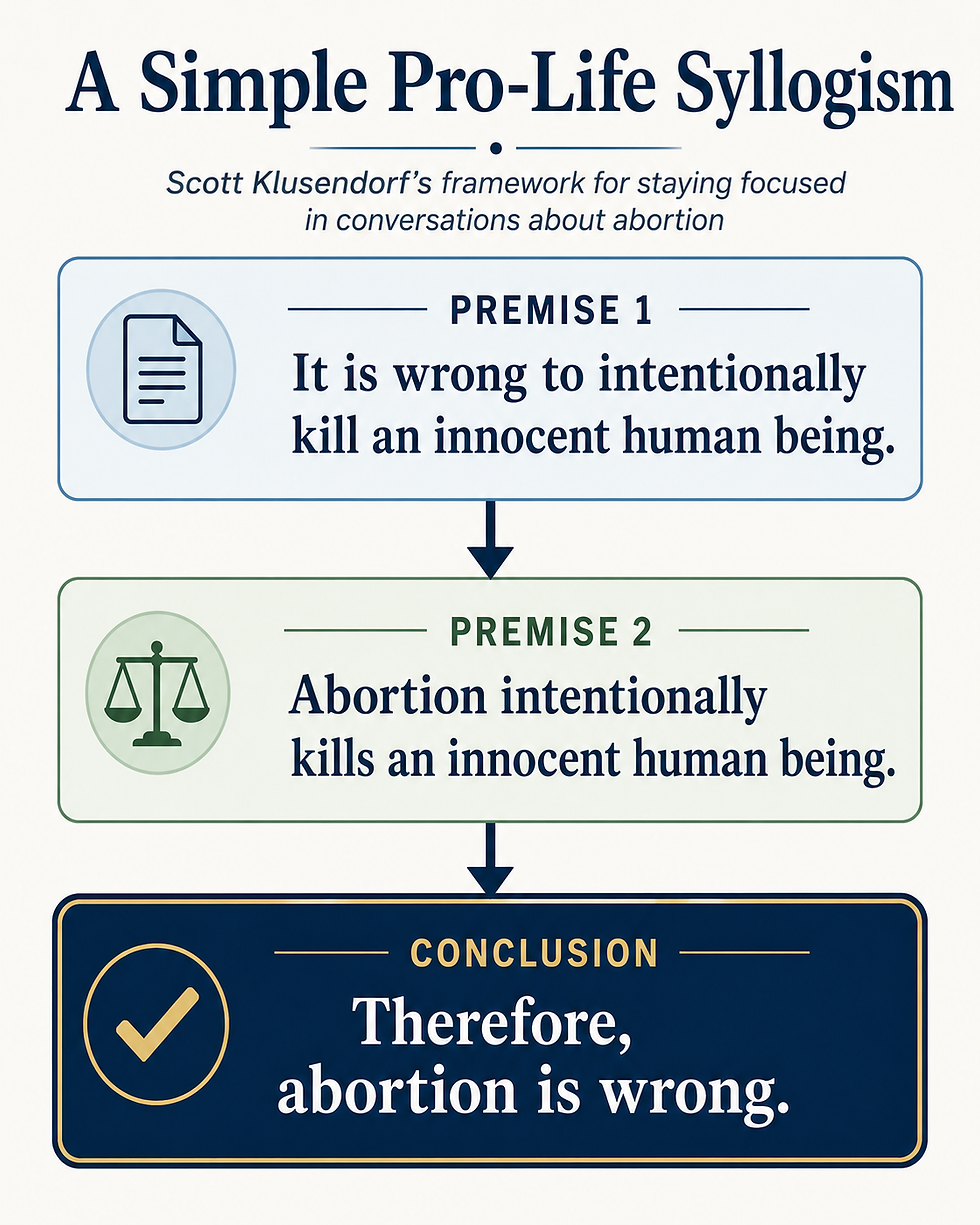
This argument, he explains, stands or falls on its own merits. It is not answered by attacking the person making it. Whether someone is male or female, religious or secular, popular or unpopular, the argument still has to be addressed.
From there, Klusendorf builds his case around three questions:
What is the unborn?
What makes human beings valuable?
What is our duty?
The first question is foundational. Klusendorf argues that many defenders of abortion simply assume the unborn are not human without actually proving it. But rather than beginning with theology, he points to embryology. From the earliest stages of development, the unborn child is a distinct, living, whole human being. The embryo is not merely a part of the mother’s body, like a skin cell. He or she is a whole human organism at an early stage of development.
The second question deals with human value. What makes human beings equal? Klusendorf warns that if human worth is based on size, development, location, or dependency, then equality quickly falls apart. Some people are bigger, stronger, smarter, more developed, or more independent than others. But those differences do not make some human beings more valuable than others.
To make this point clear, he uses the SLED framework:

Klusendorf’s point is simple: none of these differences justify killing a human being at one stage of life while protecting that same human being at another.
One of the most helpful parts of the talk is that Klusendorf gives listeners a short, practical way to explain the pro-life position in less than a minute. The argument does not require quoting Scripture, citing a church catechism, or knowing every statistic. It simply begins with the wrongness of intentionally killing innocent human beings, the scientific reality that the unborn are human beings, and the moral claim that differences in size, development, environment, and dependency do not justify killing.
For Christian listeners, Klusendorf closes with a reminder that defending life may come at a cost. Being pro-life can bring criticism, hostility, and social pressure. But faithfulness matters more than popularity. The goal is not merely to win arguments, but to be a faithful witness for truth and human dignity.
This video is a valuable resource for anyone who feels intimidated by conversations about abortion. It reminds viewers that they do not need to know everything before they speak. They simply need to know the central issue, stay focused, and begin with the question that matters most: What is the unborn?



keonhacai tv dạo này mình thấy vài người nhắc nên tò mò bấm vào xem thử giao diện thế nào thôi. Mình không có soi kỹ nội dung, chủ yếu là xem cách họ sắp xếp trang cho dễ dùng không. Ấn tượng đầu là bố cục nhìn khá thoáng, các mục được gom theo nhóm nên lướt một vòng là hiểu mình đang ở đâu. Mình thích kiểu họ trình bày thông tin theo dạng khối và bảng cột gọn gàng, nhìn nhanh không bị rối mắt. Menu cũng để chỗ dễ thấy, bấm qua lại giữa các phần khá mượt, không phải tìm hoài. Nói chung kiểu thiết kế này hợp với người chỉ muốn vào xem nhanh…